Drip irrigation is often seen as one of the most efficient ways to water crops—but one key point is often overlooked:
Drip irrigation systems do not manage themselves.
At a recent NutraDrip event in Hastings, Nebraska, Trevor shared real-world insights on how growers can improve drip irrigation efficiency, water management, and crop performance by focusing on system design, pressure, timing, and maintenance.
If you’re using drip irrigation—or considering it—these principles can help you get more out of every inch of water.
Why Drip Irrigation Requires Active Management
One of the most common mistakes in drip irrigation is treating it like an automatic system:
- Turn it on
- Let it run for 24 hours
- Assume it’s working efficiently
While simple, this approach often leads to:
- Water moving below the root zone
- Uneven irrigation across the field
- Reduced nutrient uptake
- Lower overall efficiency
Drip irrigation efficiency depends on management—not just installation.
Know Your Drip Irrigation System Design
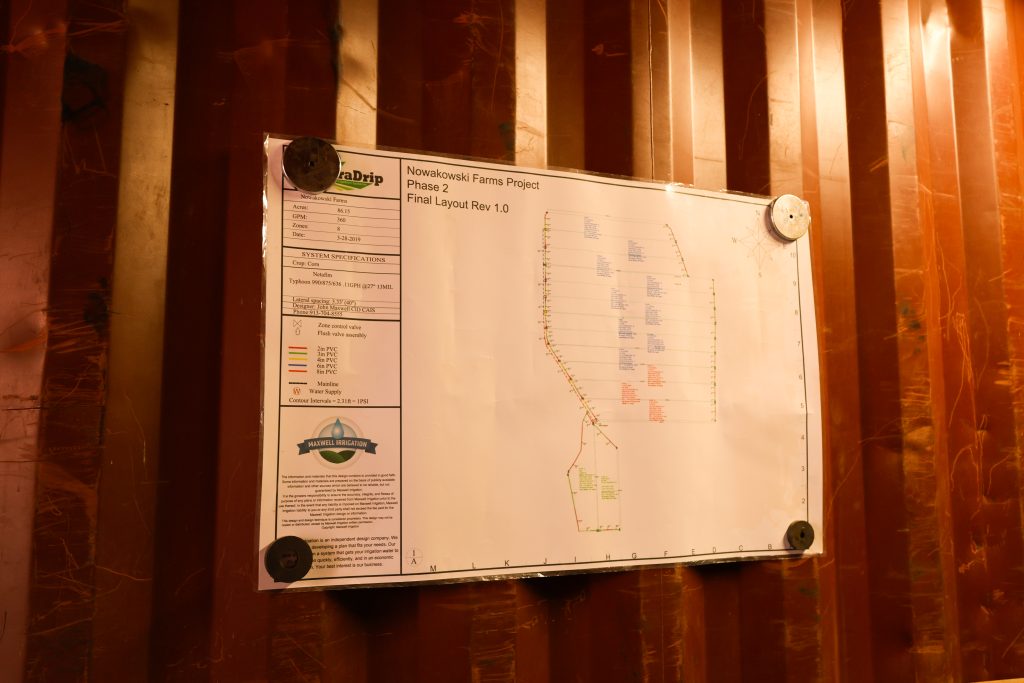
The foundation of proper drip irrigation management is understanding your system design.
Every system is built around specific parameters:
- Operating pressure (PSI)
- Flow rate (GPM)
- Zone layout
- Valve settings
- Precipitation rate (inches/hour)
Why system design matters
Without knowing your design:
- Troubleshooting becomes guesswork
- Pressure issues go unnoticed
- Water application becomes inconsistent
Example:
If your system is designed to operate at 22 PSI but is running at 14 PSI, you are not applying water as intended.
Tip: Keep your system design on file and accessible—this is essential for both growers and service teams.
Irrigation Scheduling: Avoid Long Continuous Runs
One of the most important drip irrigation practices is how you schedule your irrigation sets.
The problem with long irrigation cycles
Running a system for long periods (like 24 hours straight):
- Saturates soil near the emitter
- Causes water to move downward due to gravity
- Reduces water availability in the root zone
The solution: shorter irrigation cycles
Instead, break irrigation into smaller cycles:
- 4–8 hour sets
- Multiple cycles per day or week
This improves:
- Lateral water movement
- Capillary rise (upward movement)
- Root zone moisture retention
Think of soil like a sponge:
- Slow application → water spreads evenly
- Over-application → water drains past roots
How Much Water Are You Applying?
Understanding how much water your system applies is key to proper irrigation management.
Simple calculation:
Precipitation rate × runtime = inches applied
Example:
- 0.032 inches/hour × 8 hours = ~0.25 inches applied
Many growers target:
- ~0.25 inches per day (depending on crop and conditions)
Monitor Drip Irrigation Pressure and Flow
Two of the most important indicators of system performance are:
- Pressure
- Flow rate
Pressure monitoring
Check:
- Inlet pressure (before filters)
- Outlet pressure (after filters)
Watch for:
- High pressure → potential plugging or restriction
- Low pressure → leaks or system failure
Flow rate monitoring
Compare actual flow to design flow:
- Example: Designed for 450 GPM
- Actual: 350 GPM → potential issue
Even small differences can signal:
- Plugged lines
- Valve issues
- Leaks
Filter Station: The Heart of Your Drip System
The filtration system plays a critical role in maintaining emitter performance.
Key components:
- Sand media filters
- Backflush system
- Water meter
What to monitor:
- Pressure differential across filters
- Backflush frequency
- Media condition
Why it matters
Poor filtration can lead to:
- Plugged emitters
- Uneven water distribution
- Reduced system lifespan
Most efficient systems use:
- Three tanks
- Two filtering
- One backflushing
Valve Pressure and Irrigation Uniformity
Uniform irrigation depends on maintaining correct pressure across all zones.
Best practices:
- Check pressure at both:
- Top of field
- Bottom of field
- Use simple tools like a pressure gauge or tire gauge
Why this matters
Uneven pressure leads to:
- Over-irrigation in some areas
- Under-irrigation in others
- Yield variability across the field
Uniform pressure = uniform crop performance
Flushing Drip Irrigation Systems
Routine flushing is essential for maintaining system efficiency.
Types of flushing:
- Spring startup flushing
- In-season flushing
- End-of-season flushing
How long to flush:
- Typically 30–45 minutes per zone
Why flushing matters:
- Removes debris
- Prevents buildup in lines
- Improves emitter performance
Trevor’s rule:
You can’t flush too much—but you can flush too little.
Acid Flushing and Water Quality
Water quality directly impacts drip irrigation performance.
In some cases, acid flushing is needed to:
- Break down mineral buildup
- Address hard water issues
- Prevent emitter plugging
General guideline:
- Every ~3 years or ~27 inches of water applied
Alternative:
- Acid-based fertilizers can provide ongoing system cleaning
Pre-Watering Strategy for Dry Conditions
One of the most overlooked drip irrigation strategies is pre-watering before planting.
How it works:
- Apply water before planting
- Allow moisture to move upward through soil
- Plant into that moisture
Why it works:
- Soil naturally moves water upward (capillary action)
- Improves seed-to-soil contact
- Supports more uniform emergence
This strategy is widely used in dry regions like West Texas.
Final Thoughts: Improve Drip Irrigation Efficiency
Drip irrigation is one of the most efficient watering methods available—but only when managed correctly.
To improve performance:
- Understand your system design
- Use shorter irrigation cycles
- Monitor pressure and flow regularly
- Maintain filtration and flushing
- Adjust for water quality
- Use pre-watering strategies when needed
The difference between average and high-performing systems is management.